Whether you’re a contractor, civil engineer, plumber, or property owner facing a construction challenge, understanding core drilling could save you significant time, money, and structural damage. In this guide, we break down exactly what core drilling is, how it works, and why it’s the preferred method for creating precise holes through concrete, brick, and other hard materials.
What is core drilling?
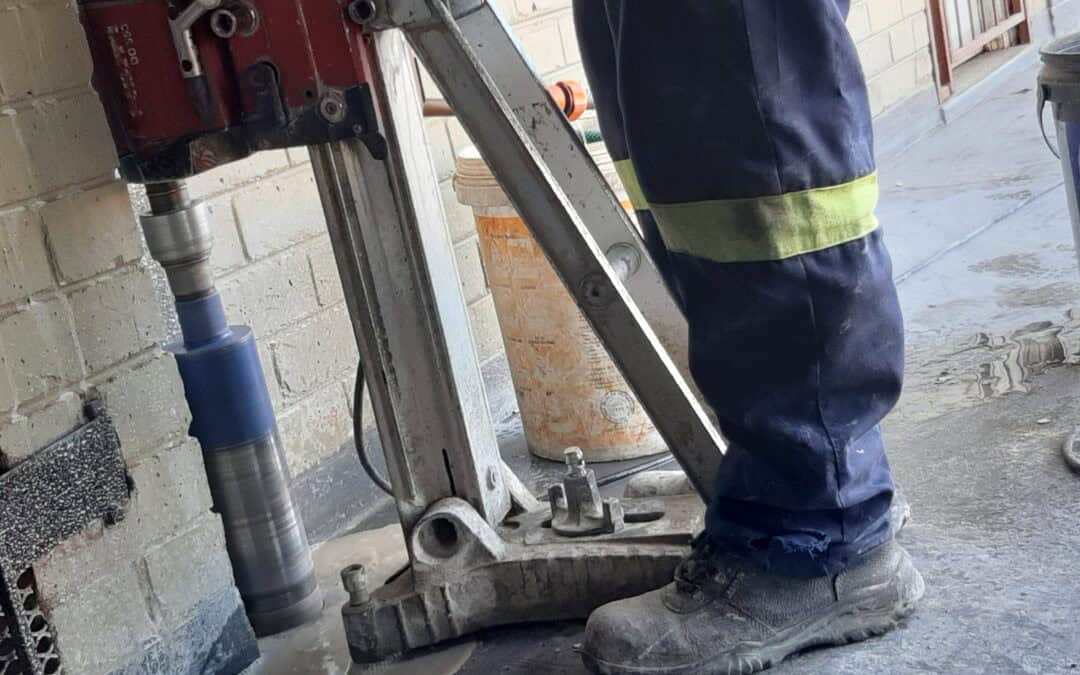
Core drilling is a specialised technique used to create clean, circular holes through hard materials such as reinforced concrete, masonry, brickwork, and asphalt. Unlike conventional drilling or breaking, core drilling uses a hollow, diamond-tipped drill bit — known as a core bit — that rotates at high speed to cut through even the most reinforced surfaces with precision and minimal disruption.
The “core” refers to the cylindrical plug of material that is extracted once the hole is complete. This core sample is often removed intact, which is particularly valuable for engineering testing or when working in areas where preserving the surrounding structure is critical.
The result is a perfectly round, smooth-edged hole — no cracking, no chipping, and no need for touch-ups. It is, simply put, the cleanest and most efficient way to penetrate hard construction materials.
How does core drilling work?
Core drilling is a water-assisted process. Water is continuously fed to the drill bit to cool it down, reduce friction, and suppress dust. Here’s a simplified breakdown of how a professional core drilling job unfolds:
- Site assessment – The drilling location is inspected, rebar positions confirmed, and access to water and power verified.
- Rig setup – The drill rig is anchored securely to the surface — either vacuum-mounted or anchor-bolted for stability.
- Drilling begins – The diamond-tipped core bit rotates under water-cooled pressure, cutting cleanly through the material.
- Core extraction – Once the hole is drilled to the required depth, the core plug is extracted and the finished opening is ready for use.
At Vus Core Drilling, we use the industry-leading Hilti DD350 drilling machine, which allows us to drill vertically, horizontally, or at angles between 0° and 45°. This flexibility means we can handle complex projects that standard drilling equipment simply cannot manage.
Our core drilling services
Core drilling is not a one-size-fits-all solution. Different projects call for different techniques. Here are the primary services we provide:
Standard core drilling
Creating clean, single circular holes for pipes, conduits, cables, HVAC ducts, and drainage systems through concrete or brick.
Stitch core drilling
A series of overlapping drill holes used to create openings too large for a single core bit — ideal for new doorways or windows in concrete walls.
Concrete cutting & sawing
Precision cutting of concrete slabs, floors, and walls using diamond saw blades for expansion joints, trenches, or openings.
Controlled demolition
Selective removal of specific concrete sections without disturbing the surrounding structure — safe, quiet, and vibration-free.
Where is core drilling used?
Core drilling is a versatile technique with applications across almost every segment of the construction and renovation industry. Here are some of the most common scenarios where professional core drilling is required:
- Installing plumbing and water supply pipes through concrete floors and walls
- Running electrical conduits and cable management through concrete structures
- HVAC and ventilation duct penetrations in commercial buildings
- Balcony and flat roof water drainage point installation
- Fireplace flue and chimney stack penetrations
- Engineering and geological sample extraction for testing
- Kitchen and bathroom renovation structural modifications
- New door and window openings in existing concrete or brick walls
Why choose core drilling over breaking or chiselling?
- Produces perfectly smooth, finished edges — no patching required
- Minimal vibration protects surrounding structure from cracking
- Significantly faster than traditional breaking methods
- Can penetrate heavily reinforced concrete with ease
- Suitable for confined spaces and occupied buildings
- Low noise and dust compared to jackhammering
- Holes can be drilled at angles up to 45°
- Any diameter from 25mm to 400mm achievable in one pass
What factors affect the cost of core drilling?
Core drilling pricing is not one-size-fits-all. Every project is assessed individually based on a combination of technical and logistical factors. Key considerations include:
- The required diameter, depth, and total number of holes
- The strength and rebar density of the material being drilled
- On-site access to a water supply and electrical power
- The drilling angle required — angled work costs more than vertical
- Whether scaffolding or elevated access equipment is needed
- Difficulty of access to the drilling location
The best way to get an accurate price is to contact us directly. We assess each job on its own merits and provide competitive, transparent quotes with no hidden fees.
Why choose Vus Core Drilling?
Founded in Johannesburg in 2009, Vus Core Drilling has grown from a two-person operation to a team of over ten highly trained specialists serving clients across Gauteng and the wider South Africa. We’ve contributed to high-profile infrastructure projects including Harambe and Rea Vaya BRT stations as well as Gautrain stations in Sandton and Johannesburg.
We operate using Hilti DD350 drilling machines — the global benchmark for professional core drilling — giving our team the capability and reliability to handle any diameter, depth, or angle your project demands. Our commitment is simple: 100% customer satisfaction, on time, and within budget.
Ready to get started? Request a free quote.
Call us on +27 83 680 2979, WhatsApp us, or submit your project details online. We respond fast.