CORE DRILLING SERVICES
CORE DRILLING
WHAT IS CORE DRILLING?
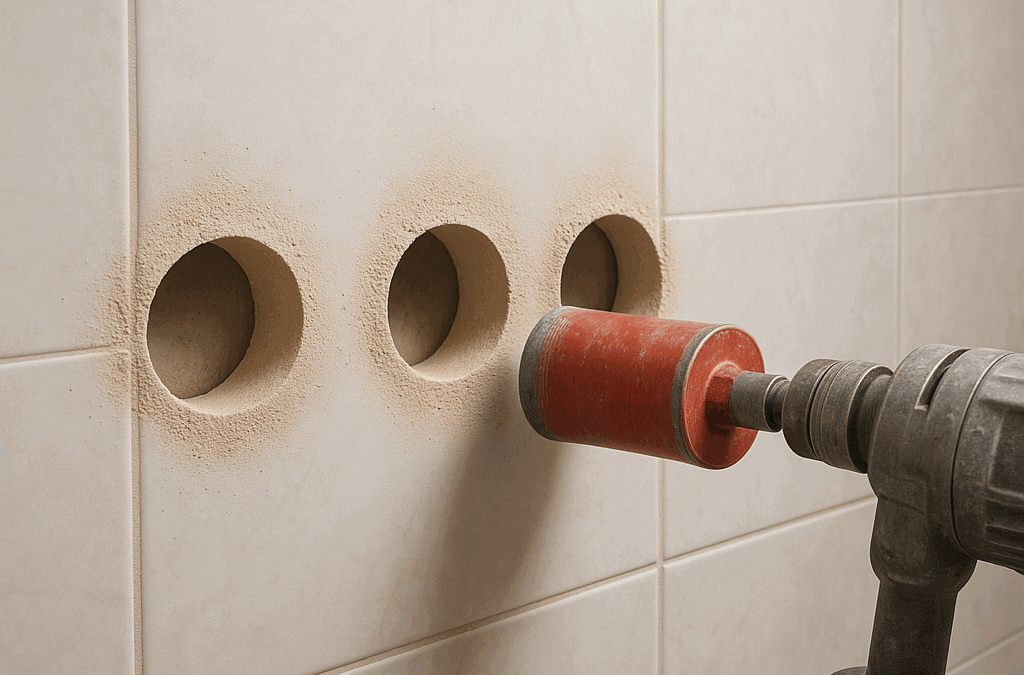
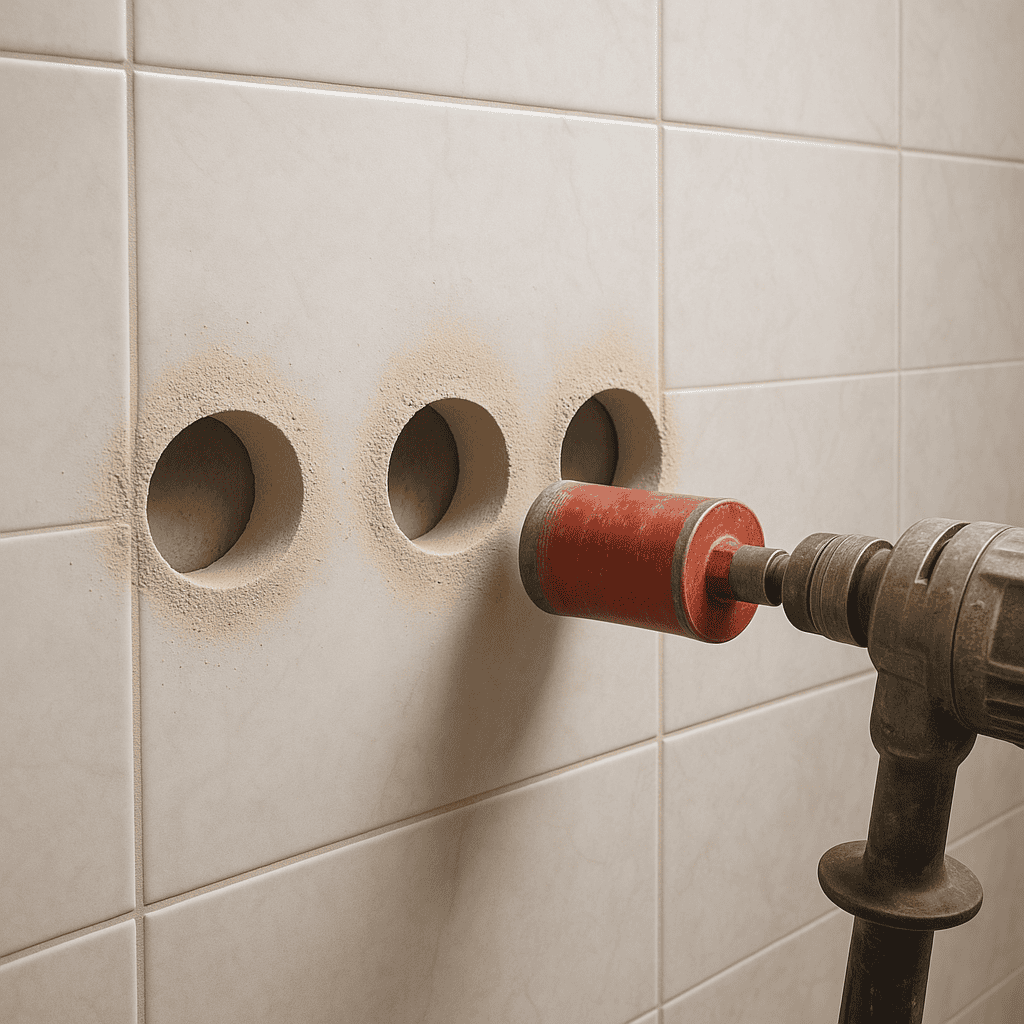
Core Drilling is the most effective method for creating precise circular holes in tough materials. Known for its speed and efficiency, it allows for clean cuts through reinforced concrete, stone, masonry, blockwork, and brick without causing unnecessary damage to surrounding structures.
This technique is widely used in construction, renovation, and engineering projects where accuracy and minimal disruption are essential. Whether drilling for plumbing, electrical installations, or structural modifications, core drilling delivers reliable results with maximum efficiency.
HOW DOES IT WORK?
Concrete coring uses core barrels and high-precision machines like the Hilti DD 350 to ensure accurate hole measurements and precise depth control. The diamond cutting face enhances accuracy, allowing for finer, more precise cuts.
A diamond core bit serves as a precision tool, creating clean, concise holes ranging from 25mm to over 400mm in diameter. Its non-percussive rotary action maintains structural integrity throughout the drilling process. Advanced water control systems keep the workspace dust-free, improving efficiency and safety.
As drilling progresses, water flows into the core bit, preventing dust buildup. A wet vacuum effectively manages the resulting slurry, ensuring a mess-free, clean finish. This method eliminates time-consuming cleanup, reducing costs and allowing installation projects to proceed without delays.
Core Drilling Applications
Industries rely on Precision drilling to create precision concrete holes for electrical, plumbing, heating, sewer, and sprinkler installations. Beyond utility work, drilling plays a vital role in anchoring bolts, lifting rods, and installing load-carrying devices such as dowel bars. Engineers also use this technique for structural analysis and rock assessments, ensuring safe, efficient construction and engineering projects.
Core Drilling Hole Diameter Range
Vus Core Drilling offers precise circular drilling through concrete, brick, blockwork and other hard surfaces. Our equipment covers a full range of diameters to suit any residential, commercial, or industrial application.
- 25mm – 50mm: Perfect for small penetrations such as electrical conduits, communication cables, and light-duty plumbing.
- 51mm – 100mm: Ideal for medium-sized openings including plumbing lines, fire sprinkler pipes, and smaller HVAC routing.
- 101mm – 200mm: Suitable for larger service conduits, ducting, downpipes, and data trunking installations.
- 201mm – 300mm: Commonly used for main plumbing lines, heavy-duty ventilation pipes, and cable tray access.
- 301mm – 400mm: Used in structural penetrations, manhole openings, core sampling, and major mechanical service entries.
Common Applications for Core Drilled Holes
The versatility of core drilling allows for a broad range of applications in commercial, industrial, and residential settings. Here’s how our hole sizes are commonly used:
- Electrical Installations – Core drilling enables clean routing for electrical conduit and power cables through walls, floors, and ceilings without damaging structural integrity.
- Plumbing and Drainage – From small supply lines to major sewer pipes, our hole sizes accommodate various plumbing installations in new builds and renovations.
- HVAC and Ventilation – Precision core holes are crucial for ducting air conditioning systems, exhaust fans, and fresh air inlets through concrete walls or slabs.
- Structural Reinforcement and Retrofitting – Larger holes (up to 400mm) are often used for installing steel columns, dowels, or concrete reinforcement in retrofitting projects.
- Core Sampling and Testing – In geotechnical or structural testing, core holes provide clean material samples from concrete or masonry for lab analysis.
- Fire Protection and Sprinkler Systems – Clean and accurately placed holes are necessary for routing fire suppression piping without compromising fire-rated barriers.
Concrete coring is a powerful solution for installing drainage systems in boundary walls, garages, and concrete roofs, preventing flooding and water damage. This precise technique also enables the seamless installation of windows, air purifier vents, and other fixtures, ensuring structural integrity.
By integrating concrete coring into drainage systems, homeowners can safeguard their property from water-related damage and mold growth. Whether installing a new drain in flood-prone areas or adding a sink in a basement or garage, concrete coring delivers precision, versatility, and efficiency for every project.
Drilling holes in the pavement, floor, walls, roofs, or sloping surfaces with concrete.
Hole core dimensions range from 25mm to 400mm in diameter.
Drill to the depths you specify
Extensions can be used to reach any depth.
Hole cutting at any angle
BENEFITS OF CORE DRILLING
Hole cutting, in addition to its accuracy and meticulous attention to detail, has several advantages over other, more invasive procedures.
These advantages include:
Low noise levels due to limited vibrations
Works perfectly in confined areas
No problems with structural integrity
The most cost-effective way to achieve professional, safe, and precise Hole cutting work is to hire a core drilling contractor. If you need diamond core drilling, please give us a call or send us an email for a quote.
STITCH CORE DRILLING
Stitch Drilling is a highly effective technique for creating large holes and slots in walls and floors, particularly in areas with restricted access. This method involves Diamond Stitch Drilling, which achieves precise openings by drilling a sequence of overlapping core holes.
When conventional drilling methods do not yield the desired results, stitch drilling provides a flexible alternative. By strategically overlapping core holes, it allows for the formation of holes of any size or shape, offering unmatched versatility in structural modifications.
BENEFITS OF STITCH CORE DRILLING?
Ability to drill in smaller spaces.
The ability to cut any shape, depth or size.
The general cleanliness of the work space.
Eliminate waste and cutting by-products.
CONCRETE CUTTING OR FLOOR SAWING
Floor sawing is a fast and precise technique used to modify flat structures such as concrete floors, roadways, bridges, and suspended slabs, with cutting depths of up to 500mm. On roadways, floor saws efficiently cut asphalt and concrete, allowing for swift repairs and modifications while maintaining clean, straight edges.
This method is ideal for cutting through reinforced concrete, pre-cast concrete, and other structural materials when level and flat surfaces require modification. Floor sawing plays a crucial role in creating expansion joints, openings for ducts, elevators, stairwells, machine pads, conduit trenches, and controlled demolition. It is widely used across applications such as floors, rooftops, bridge decks, and suspended slabs, ensuring a smooth, precise finish that simplifies subsequent paving and pouring.”
CONTROLLED DEMOLITION
What is Controlled Demolition?
Controlled demolition is a precise and systematic method of deconstructing structures to achieve specific project goals while maintaining strict safety standards. This approach minimizes disruption to surrounding buildings and the environment, ensuring an organized and efficient process. Often confused with large-scale demolitions involving explosives and heavy machinery, controlled demolition instead focuses on carefully dismantling sections of a building with precision and strategy.
Safety remains the top priority, as sections are dismantled in a timed manner, preventing unintended damage to nearby structures. Additionally, dust and debris are effectively managed to maintain a clean and controlled workspace. At Vus Core Drilling, we employ advanced equipment to ensure optimal precision in every controlled demolition project.
CONCRETE SCANNING & REBAR SURVEYS
What Is Concrete Scanning & Rebar Survey?
Concrete scanning — also known as GPR scanning or rebar detection — is a non-destructive testing (NDT) method that uses radar pulses to detect and map reinforcing steel embedded within concrete structures. A rebar survey provides engineers, contractors, and project managers with accurate data on the exact position and depth of rebar before core drilling commences.
This service is essential for:
- Core drilling and concrete cutting projects
- Pre-construction slab inspections
- Structural assessments and load-bearing evaluations
- Determining safe drill point locations in reinforced concrete
- Renovation and retrofitting projects on existing structures
- Any project where rebar location and depth must be confirmed before penetration
OUR CONCRETE SCANNING SERVICE INCLUDES:
- GPR (Ground Penetrating Radar) scanning of slabs, walls, and columns
- Rebar location and depth mapping
- Rebar spacing and layout analysis
- On-site marking of rebar positions for immediate use by your drilling team
- Detailed scan reports for engineers and project records
- Fast turnaround with same-day options available
- Coverage across Gauteng and national project sites
Why Rebar Surveys Matter
Striking reinforcing steel during a core drilling job damages your diamond bit, can compromise the structural integrity of the concrete element, and creates costly rework. A rebar survey eliminates the guesswork — telling your operator exactly where the steel is and how deep, so drill points can be positioned safely and precisely.
At VUS Core Drilling, we recommend every core drilling job begins with a scan. Our GPR surveys are fast, non-invasive, and deliver results on-site so your team can proceed with confidence


